DESIGN DEBATE
 PREFERRED
CONSTRUCTION DESIGN FOR CONCRETE FOUNDATIONS & HISTORIC STREET-
PREFERRED
CONSTRUCTION DESIGN FOR CONCRETE FOUNDATIONS & HISTORIC STREET-
A modified-aggregate stone foundation topped with sand, then pavers
- no cement
(see:
Jessup Street
Report: Condition Assessment And Recommendations
by Milner + Carr Conservation, LLC,
Philadelphia, PA (Oct 2010). Currently, the
Streets Department is using 8-12 inches of concrete as a base. We have
strongly urged them to use something similar to the Netherland's model
(see below).
SPACING, SMOOTHNESS, & ADA COMPLIANCE: The bricks and stones should
be tightly set, and in some cases, stone pavers should be ground smooth
in order to make walking and biking safe and easy, and to be compliant
with The Americans With Disabilities Act (ADA). See
NYC
Historic Districts Council
shares
these concerns in a report
and NYT
article:
http://www.nytimes.com/2013/03/30/nyregion/time-is-past-for-many-of-citys-old-cobblestones.html?pagewanted=all&_r=1
or (doc)
SIDEWALK GRADIENT (i.e, slope): The restoration of historic streets should include in the bid contract a requirement that all sidewalk gradients be in compliance with Street Department standard of 1/4 inch per foot, and if such is not the case, curbs should be reset to be in compliance with that standard.
The case FOR “modified aggregate and screening” &
AGAINST "concrete foundation & mortar":
|
FOR MODIFIED AGGREGATE FOUNDATION |
AGAINST CONCRETE FOUNDATION |
|
FOR REPAIRS: |
FOR REPAIRS: |
|
|
|
|
|
|
|
|
|
|
|
|
|
|
|
|
FOR PERMEABILITY: |
FOR PERMEABILITY: |
|
Allows for slow permeability which keeps streets drier and safer in icy conditions, although storm drains are still necessary for stormwater runoff. It also protects pavers from water damage & nearby properties. And promotes a dryer environment which is better for mosquito control. |
Damages pavers: Creates a wet environment which is particularly harmful for wood and brick pavers, as well as stone. Camac Street, The Wood Street, between Walnut and Locust completely rotted away due to concrete foundation under a sand layer, as well as the type of wood. Black locust, Osage Orange, or another water-tolerant species of tree should be used or at least experimented with.
Increases Health & Safety concerns: Creates conditions that breed
mosquitoes
|
RESTORATION REPORTS AND EXAMPLES:
Very good 58-page manual: DUBLIN, IRELAND: PAVING THE CONSERVATION OF HISTORIC GROUND SURFACES
Netherlands: TigerStone http://tiger-stone.com/ (paver installation company). From a Tiger-Stone representative, "In the Netherlands we use 15 inches of concrete debris ( pulverized concrete) and on top 2 to 6 inches of sand ( of good quality, not like the sand on a beach…) In a lot of countries the use stabilized sand, this is a mixture with cement. The most important is that the base construction is solid so in the long term the road quality can be guarantied. We use sand on the last few inches because the ‘’old’’ stones are not likely to al have the same dimensions. The sand does have the compacted with a compacting plate before paving the stones."
From Davenport, Iowa: "We generally use six inches of 95% proctor compacted ¾” down (with fines) crushed stone material for the base, with about 1” of sand on top of that. We vibrate the bricks into the sand, then sweep more sand over the top and vibrate again to get the sand to fill the gaps between the bricks. On hills we mix in 1 part mortar to 3 parts sand to prevent the sand mixture from washing away."
From Willmette, Illinois: "This work shall consist of removing existing bricks in streets at various locations determined by the ENGINEER; removal of the existing deteriorated stone base to a depth of 6 inches, placement of a new 6 inch CA 6 base (CA is crushed aggregate), a 1 inch sand layer and replacement of the bricks."
Brick Pavement Repairs, 6 inch Stone Base: used for brick repairs , with settlement
Brick Pavement Repairs, 13 inch Stone Base: used for brick repairs , with a lot of settlement
Portland, Oregon: http://www.portlandoregon.gov/bes/article/7... Streets are excavated to full depth, about 13 to 18 inches below top of curb. Drainage geotextile fabric is placed on the ground surface, and a layer of 2”-minus rock drainage blanket 6-10 inches deep is laid on top of the fabric and compacted. ... The permeable pavers are then installed on the leveling bed. The space between paving blocks is filled with the fine rock, and rock and pavers are compacted. (Lynn Landes: We don't agree with using geotextile fabric as it interferes with excavation for repairs, and also interferes with subsidence, which acts as an early warning system for the formation of catastrophic sinkholes.)
MORE ON HISTORIC RESTORATIONS:
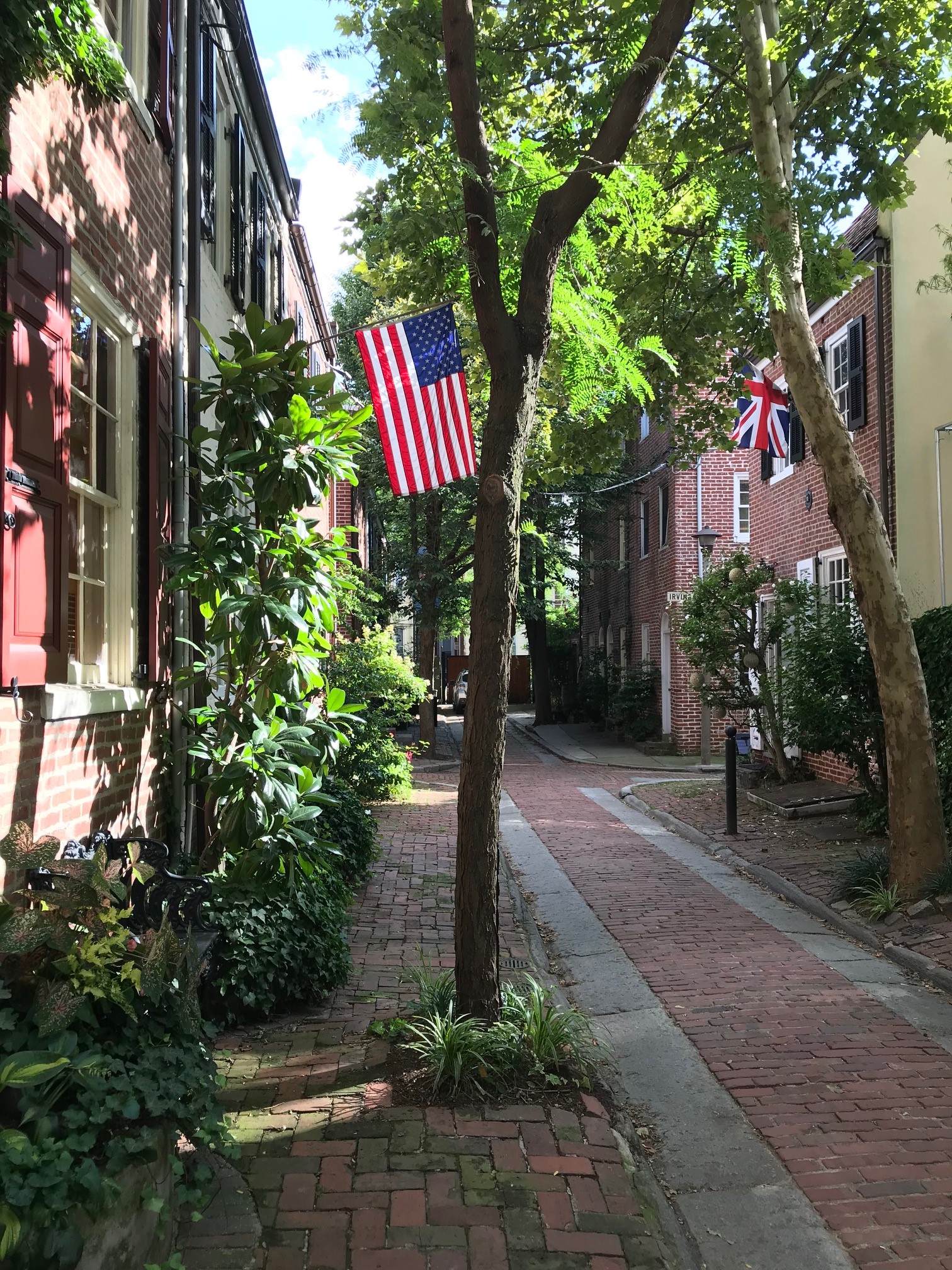
Philadelphia: Historic Assessment and Recommendation Report: October 2010, 200 block of South Jessup Street by Milner + Carr Conservation. Jessup Street was restored in 2012. The results of the work done was somewhat predictable, as the Streets Department insisted on laying a concrete base against the report's recommendation of modified aggregate for the foundation. In general, the restored streets by contractor Spaventa & Sons (http://dspaventa.com), look great (200 blocks of Jessup and Warnock, 1300 blocks of Cypress and Panama). However, the mortar between the bricks is crumbling in some places, the streets are not porous and are therefore holding water, and the Belgium blocks are placed too far apart for safe and comfortable walking and riding (in cars or on bikes). On Jessup Street there is a new crack straight across the road just next to our house (217), breaking one of our old granite gutter stone in half. We believe that the crack is the result of the concrete being laid in one continuous stretch and encompassing all the street elements, not allowing for any breaks and therefore no 'give'. That said, the restored historic streets look really good.
Washington Place, Troy, NY:
O & P Streets, Georgetown, DC:
OTHER RESOURCES--
Small Streets
Phil
LaCombe, Director and Co-Founder
email: phil@smallstreets.org
web:
http://smallstreets.org
mobile: 413.648.7445
Paul Daniel Marriott &
Associates
3140 Wisconsin Avenue,
NW
Suite 804
Washington, DC 20016
info@historicroads.org
http://www.historicroads.org